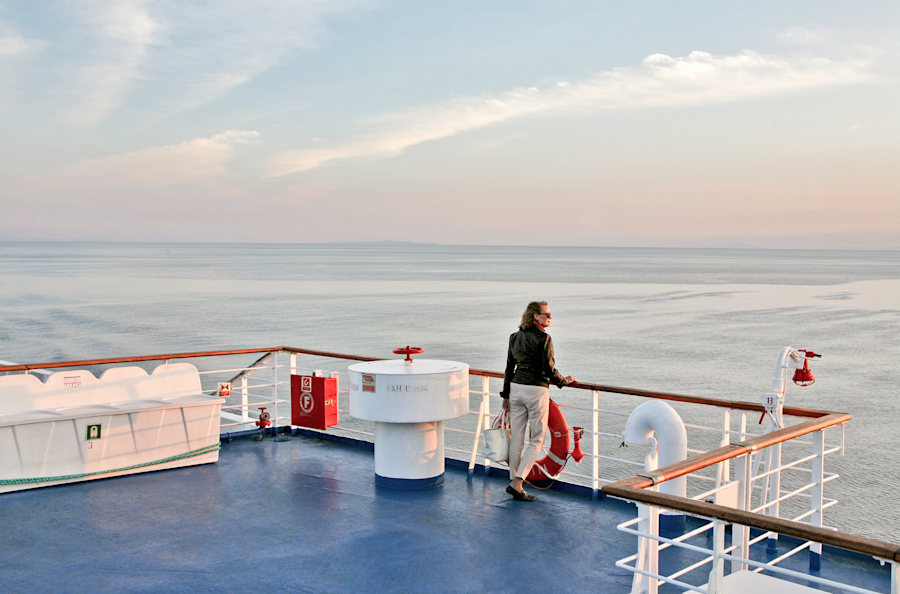
Hoping to avoid feeling green on the waves? Check out these expert tips to keep your high seas adventure easy, not queasy.
How to Conquer Motion Sickness on Your Next Cruise
By Anna-Kaisa Walker | January 27, 2025

Illustration by Kelsey Davis
Since the world’s earliest ocean journeys, travelers have experienced the “plague at sea” — the motion sickness that could strike all but the most experienced sailors. In fact, the word “nausea” derives from the ancient Greek word naus, meaning “ship.” Fortunately, today’s state-of-the-art cruise ships are more like floating hotels than sailboats and, most days, it’s unlikely you’ll sense much motion. However, seasoned cruisers know to be prepared for all kinds of weather. Read on to learn how to make your next sailing a breeze. What causes seasickness, and how likely am I to experience it on a cruise? Motion sickness comes from your nervous system, not your stomach. “Seasickness happens when your body, your inner ear and your eyes are all sending different messages to your brain,” says Penny Gleave, a registered nurse and owner of TravelSafe, a pre-travel health and immunization clinic in Vancouver. On a ship, your body may sense the pitching and rolling motion of large waves, but when your eyes don’t register the movement, it can lead to uncomfortable sensory confusion. Motion sickness affects about one-third of the population, with women more susceptible to it than men. That said, the bigger the vessel, the less motion you’re likely to feel — if you feel any at all. In the last 20 years, the average cruise ship has doubled in size to more than 1,000 feet in length with a gross tonnage of more than 170,000, and many are also equipped with fin-like stabilizers that minimize side-to-side rolling.
Plan an unforgettable cruise.
If I’m prone to motion sickness, are there destinations to be avoided or sought out? “The Caribbean Sea outside the June-to-November hurricane season, and the Mediterranean Sea in spring and summer are your best bets for calm waters,” says Mark Greenwood, a Vancouver-based travel advisor. If you shudder at the thought of high winds and rough seas, steer clear of the Tasman Sea between Australia and New Zealand, the Bay of Biscay off western France and the Drake Passage from Chile to Antarctica. Which stateroom should I book to minimize motion? The lower down you are in a ship, the closer you are to its center of gravity and the more stable you’ll feel. A midship state- room with a balcony is ideal, for access to both fresh air and the view. “Watching the horizon can help your brain make sense of the ship’s movement,” says Gleave. What remedies should I pack? For mild seasickness, many cruisers swear by bands that gently press the inside of your wrist, where the groove between the two tendons is said to be a nausea-relieving acupressure point. Ginger, taken in the form of tablets, candy or tea, is also a popular stomach soother. For more rollicking waves, some general practitioners may prescribe a patch containing scopolamine, worn on the skin for up to 72 hours. “Check with your doctor to ensure it’s a suitable option for your age and health history,” advises Gleave. Her tried-and-true remedy is over-the-counter antihistamine medications like Dramamine, taken at least 30 to 60 minutes before bad weather hits — the captain’s briefing should give you plenty of notice if rough seas are ahead. ✦