High in the Tyrolean Alps, alpine sport meets folk tradition — and plenty of schnapps — at the Lederhosen Wedel Finale.
Finding Kinship at Austria’s Folkiest Spring Ski Festival
By Jennifer Malloy | January 13, 2026
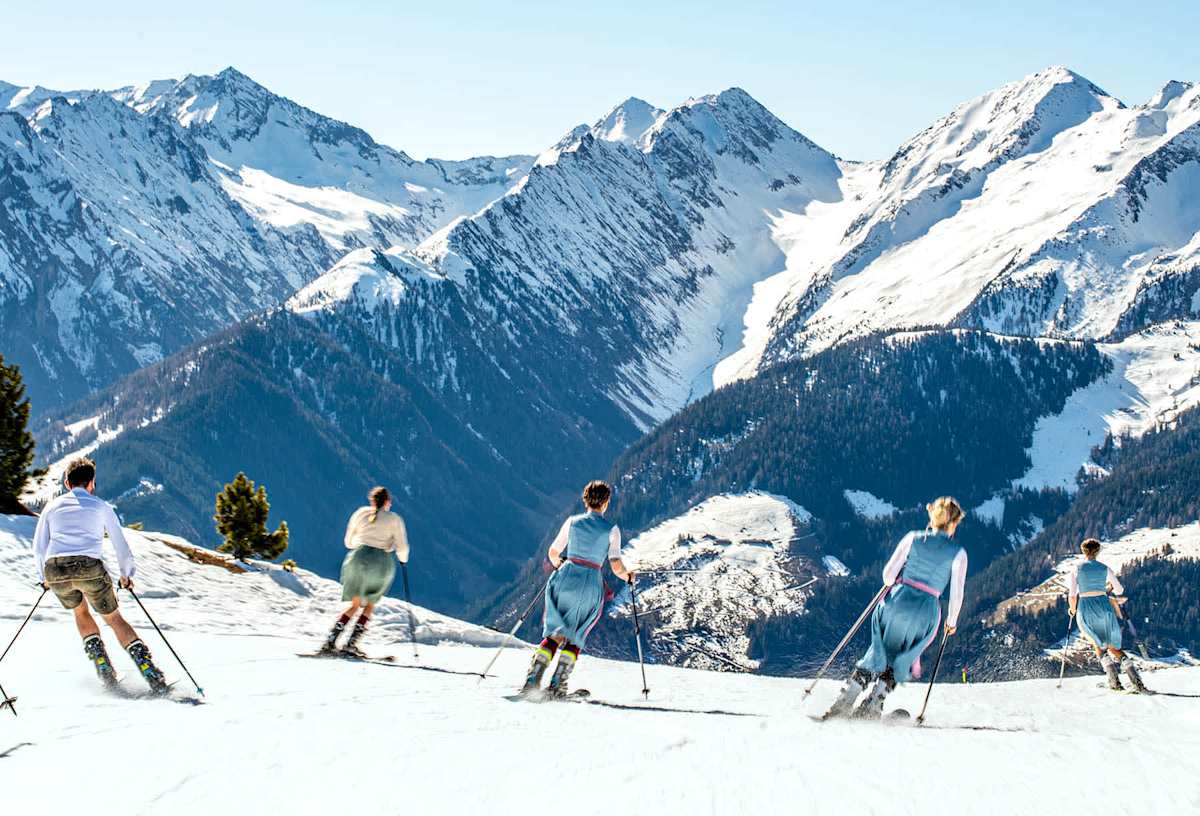
The Lederhosen Wedel Finale invites skiers to celebrate Austrian Alpine tradition and to ski wearing dirndls and leather breeches.
Kari Medig
“It’s tradition to stick the lid on your nose.” I’m staring at the frothy, clear liquor in the bottle before me, standing with four strangers I met moments ago. We bang the miniature bottles against the palms of our hands and, adhering to custom, affix the caps firmly to our noses. Then we begin to chant: a low, repetitive hum of the German word zum, meaning “together.” The rhythm builds — zum, zum, zum, zum, zum, zum, zum, zum — growing louder, pitching higher, until we crescendo in a whooping holler. We thrust the tiny flasks of Berliner Luft schnapps into the air and drink. The glass glints against an alpine backdrop, the air sizzles with the smell of frying Wiener schnitzel, and the notes of an accordion mingle with the sharp crack of a Goaßlschnalzer, a Bavarian whip-cracker. The rhythmic snap is said to drive the last of winter away, and the crowd answers the call with a cheer that echoes through the valley. Earlier this morning, before I joined the heaving swell of the festival, I had unpacked a borrowed dirndl, the traditional women’s outfit of Alpine Austria. As I ran my hands over the soft cotton, admiring the sky-blue color and the decorative embroidery adorning the apron, a quiet thrill ran through me. Slipping it on — tightening the bodice, smoothing the skirt — I felt myself click into the rhythm of the event, as if the outfit itself were an invitation. By the time I board my first ski lift of the day, I am stepping into something larger than myself. And as I make my way through the festival crowd, I feel the tug, the welcome, the sense of being folded in.
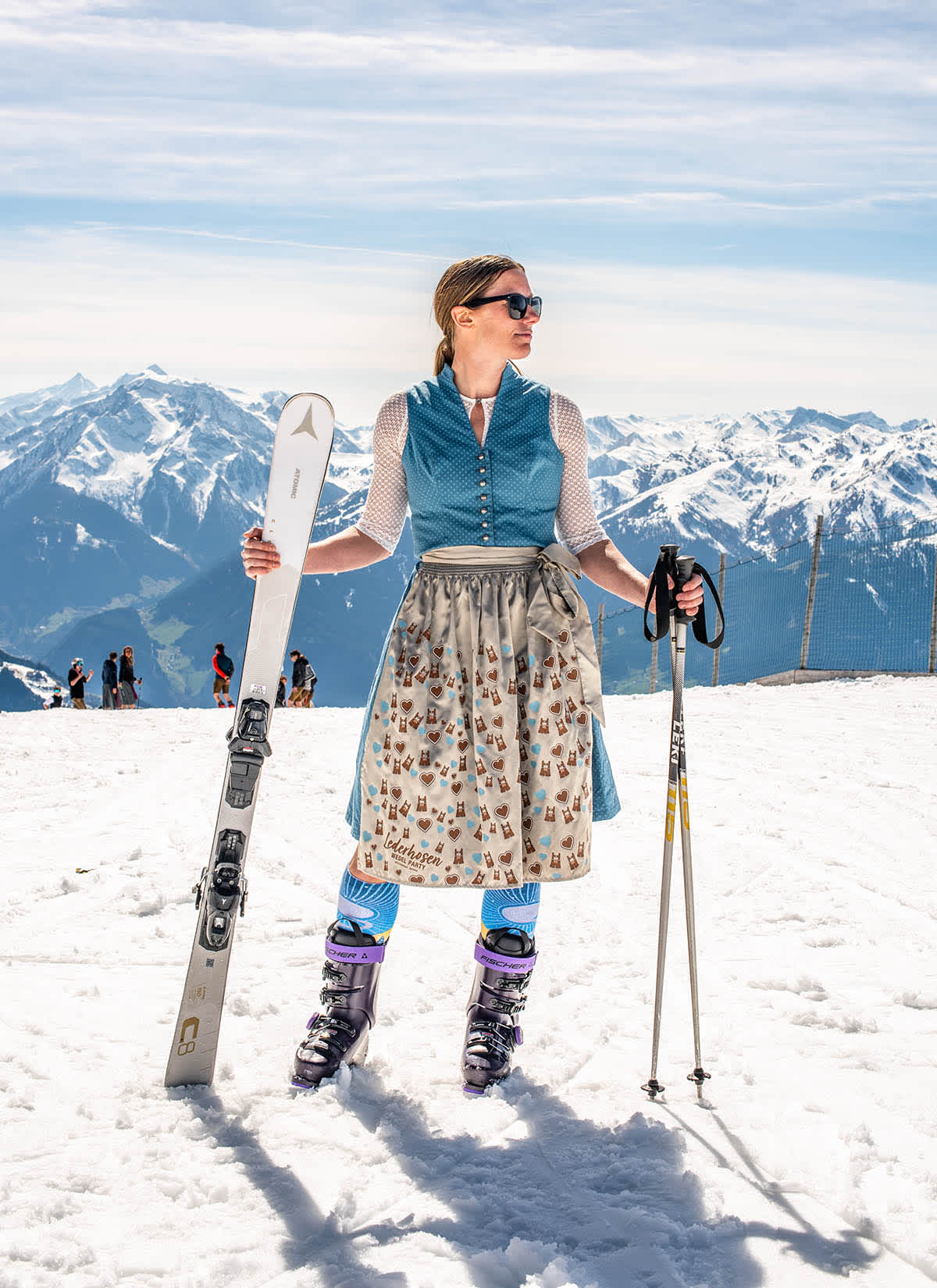
Writer Jennifer Malloy poses in an Austrian dirndl: bodice, skirt and apron.
Kari Medig
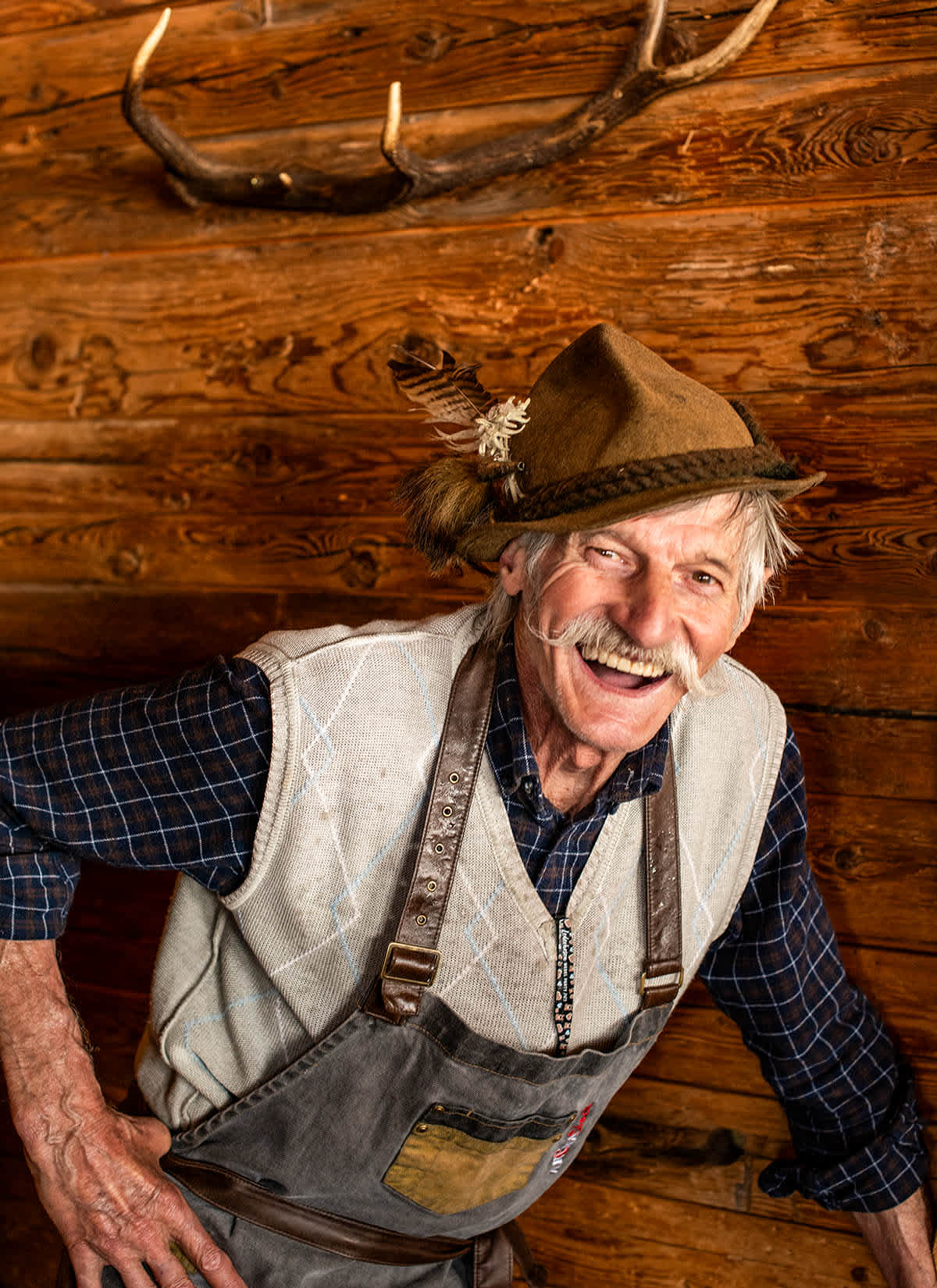
A popular local, Josef Steinberger holds court in the Arena Stadl mountain hut.
Kari Medig
This feeling of togetherness is at the heart of the Lederhosen Wedel Finale, held high up in the Zillertal, or Ziller Valley, of the Tyrol region — the cradle of Austrian ski culture. Wedel refers to a skiing technique, and on this April weekend I join hundreds of festivalgoers wearing dirndls, lederhosen and ski boots to celebrate winter’s end and spring’s arrival. In this setting, four strangers in skis and breeches turn into fast friends. Borders blur, nations unite and language barriers slip away like skis on a steep slope. “We are united by a sport,” says Max Sprenger, one of the servers at Arena Stadl, the highest mountain hut in the valley, where we’re gathered. Perched at 7,874 feet (2,400 meters) of elevation, the cozy wood-framed retreat combines rustic charm with sweeping views of the surrounding glaciated peaks, connected by more than 50 lifts and cable cars. The outdoor patio has been transformed into a lively dance floor bordered by hay bales where giggling girls in rainbow-colored dirndls pose for photos. “You meet people from all over the world, and we live the Austrian custom of skiing by spending time together,” Sprenger says, gesturing to the boisterous crowd around us. “It’s a big family, full of passionate people who keep coming back, even if they live far away.” The Lederhosen Wedel festival started in 2013 as a spirited warm-up to Gauder Fest — one of the country’s oldest folk festivals — which attracts more than 30,000 revelers to the town of Zell am Ziller on the valley floor. Today’s joyful tribute to the Austrian Alpine spirit is happening on the snowy slopes above. The day begins with a parade of skiers, dressed in old-timey garb, at the base of Zillertal Arena, a vast ski area that reaches from 4,100 up to 8,200 feet (1,250 to 2,500 meters) above sea level.
Plan your dream trip.
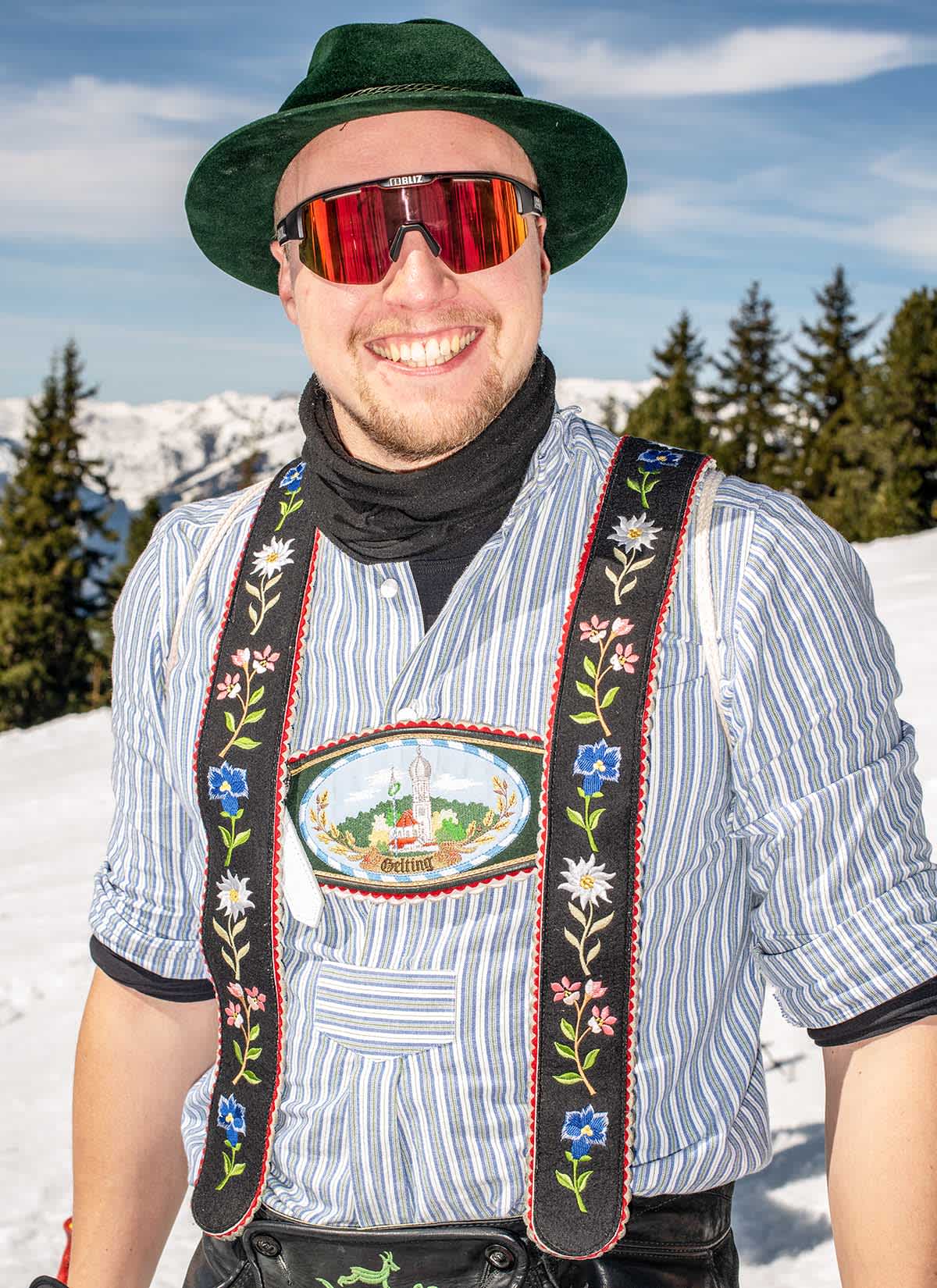
The observance of tradition takes all forms at the Lederhosen Wedel festival.
Kari Medig
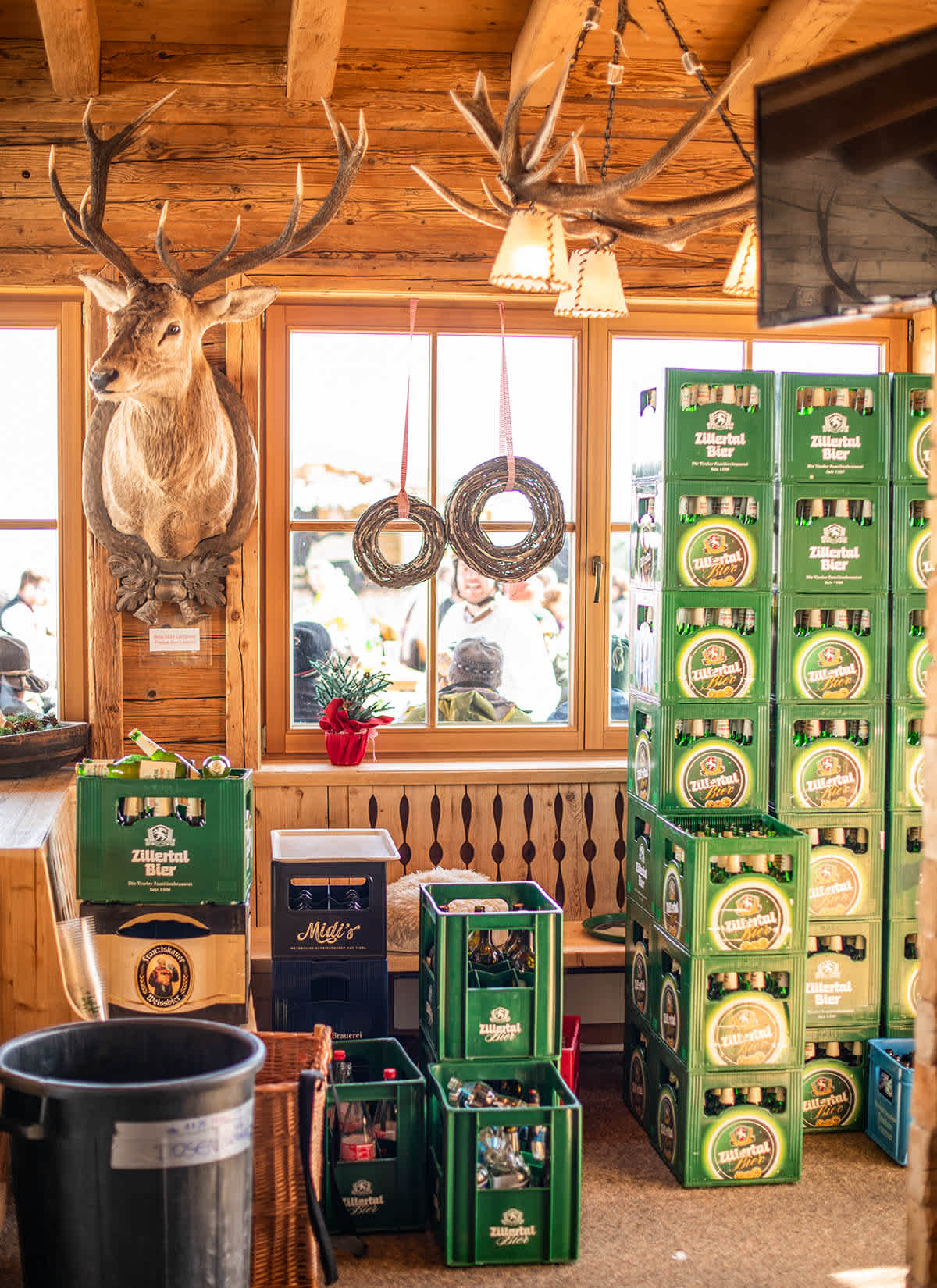
The Arena Stadl hut is well-stocked in anticipation of the spring skiing party.
Kari Medig
In the Ziller Valley and in Austria, skiing isn’t just sport — it’s deeply embedded in the local and national culture. Children learn to ski almost as soon as they can walk, and local clubs foster lifelong devotion. Schools close for ski days and shut down for a week on the peaks each winter. “It’s a tradition. Everybody skis,” says Christian Daum, part of the Gauder Fest organizing team. He’s just taught his own three-year-old daughter, he proudly tells me. I’m wrapped in sky-blue fabric, and the skirt of my dirndl swishes awkwardly against my rigid ski boots. The crowd is a kaleidoscope of color: cleavage-baring Dirndlblusen (blouses), Schürzen (aprons) of pale blue, soft yellow and muted pink, and neatly braided hair. The party spreads up and down the slopes. Nearby, women in dirndls with white veils and tiaras celebrate what Austrians call Poltern, or bachelorette parties. Folk music blares from Bluetooth speakers carried by men in gingham shirts, gilets and lederhosen. A group beside me hauls a case of beer up the lift stairs and pops the tops with celebratory flair before loading into the gondola with me. I catch another cable car and ski down to a chairlift, then up and down again, making my way to another of the Zillertal’s lively mountain huts. A blur of skirts and braids zips past me. The day is warm, and skiing without snow pants or a winter coat is thrilling, if slightly nerve-racking: What if I take a tumble? The hem of my skirt floats and swirls around my legs and my apron flutters in the wind as I pick up speed. The outfit transforms every turn into a dance, my skirt billowing in rhythm with the slopes. After another icy run — it’s not yet warm enough for Firn, the soft, slushy snow that forms atop the ice — I arrive at the Kreuzwiesenalm mountain hut, already swarming with revelers. A man in a dinosaur costume storms the dance floor while a couple twirls beneath a backdrop of snowy peaks. The owner’s son, a young boy dressed in pint-sized lederhosen, opens beers for the crowd. Platters of eggs, speck, crusty bread, mountain yogurt and jam-filled doughnuts are served alongside beer, white-wine spritzers and schnapps. I snag a cup of rich espresso and inhale the scent of freshly ground beans against the crisp Alpine air.
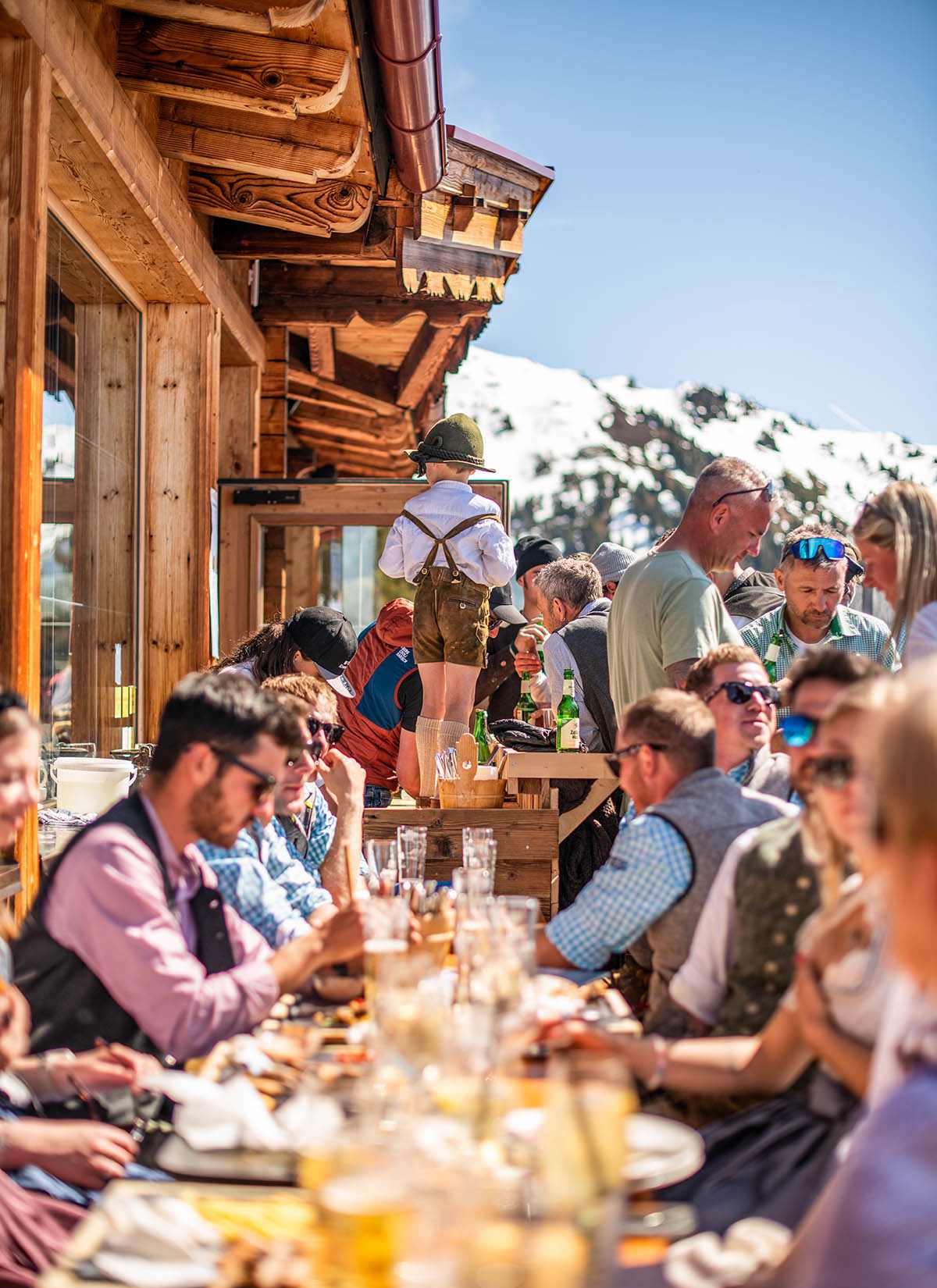
Skiers breaking their fast at the Keuzwiesenalm mountain hut.
Kari Medig

An elevated ski breakfast of sausage and pretzel, served at 5,000 feet.
Kari Medig
For young people, the pastime extends beyond the slopes. “It’s a mixture of skiing and après-ski,” says student Lea Rahm. “A little more of the après-ski,” laughs her friend Laura Rampl. Austria’s take on slopeside culture — glühwein and all — is renowned for Gemütlichkeit, the warm, happy feeling you get when connecting with friends. “It’s really about the people,” says Rahm. Indeed, the laughter, shared meals and music bring people together in a way that I haven’t experienced at other ski resorts. Skiing may bring them here, but I sense that it’s the relationships that form in its wake that keep people coming back. A group from Bavaria tells me it’s the relaxed atmosphere that makes genuine connection possible. This is a place where conversation flows freely — when people aren’t dancing, that is. A live band starts playing a popular folk tune; there’s hooting, hollering and clapping. The dance floor fills with swirling skirts and embroidered shorts. The energy is contagious. On the sidelines, men use spoons to drum rhythms on their leather-clad thighs. I step onto the floor. My movements are clumsy in ski boots, but no one notices. I stomp, twirl and let the music take me. My blue dirndl flares with every spin. It’s a moment of pure belonging — and a moment is all I need. ✦
Explore More
A Heli-ski Expedition of a Lifetime in British Columbia: Pristine wilderness, Indigenous culture and out-of-this-world heli-skiing conditions collide on this epic adventure into British Columbia’s Bella Coola Valley. The World’s Best New Hiking Trails: There’s no better way to feel a place than to walk it. From Sweden’s green paths to the storybook terrain of Jordan, these new hiking trails are proof. Inside Kanazawa’s World of Traditional Crafts: Artisans in Japan’s epicenter of crafts, are preserving traditional ways by reinventing them for modern life — and visitors have a role to play. Follow Range on Instagram, Facebook and Pinterest. Sign up for the Range newsletter to receive expert advice, award-winning stories and the latest travel trends in your inbox.