Verdant grasslands, dramatic skies, newborn wildlife and no other vehicles in sight: A shoulder-season safari in these storied plains shows the luxury of solitude.
A Green-season Safari in Kenya’s Maasai Mara
By Jen Rose Smith | April 7, 2026
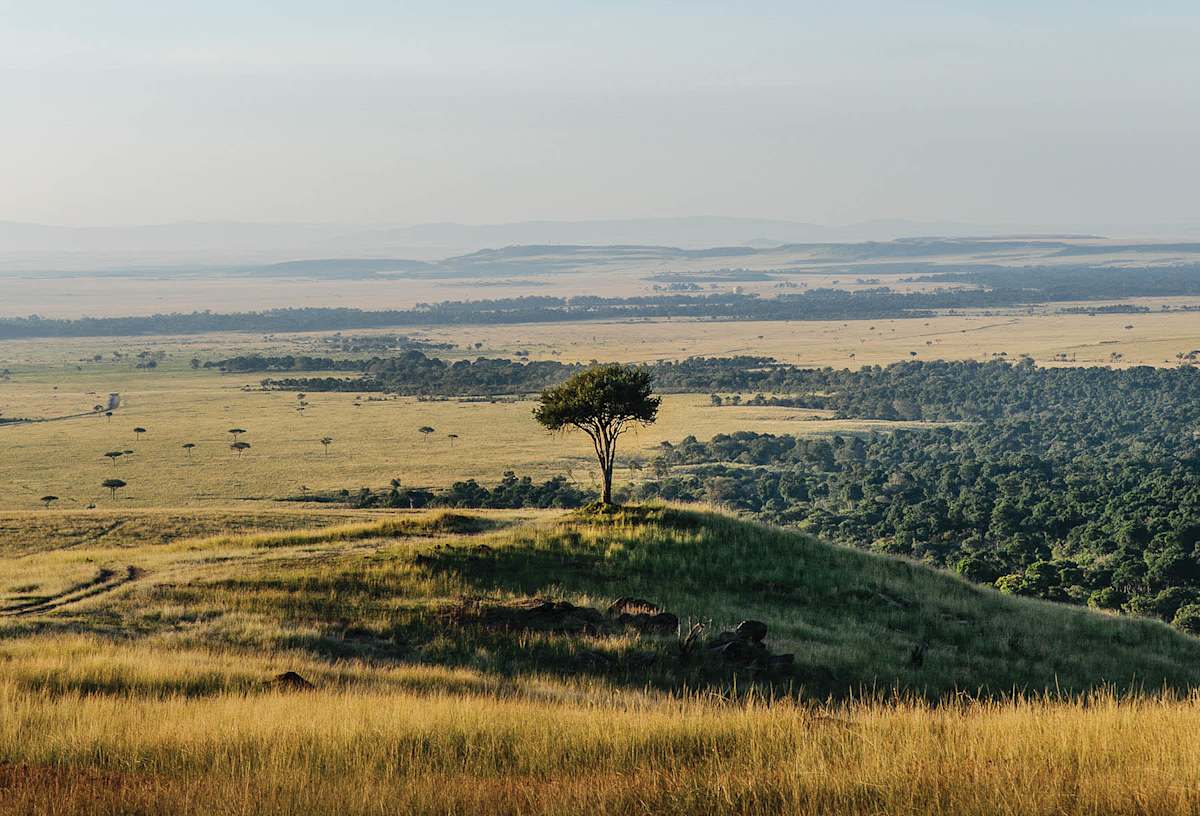
During the Maasai Mara’s season of “long rains,” afternoon showers are frequent, but the reward is a green savanna.
Alex Crétey Systermans
The tail hangs plumb from an acacia’s thorny canopy, swaying in the slantwise afternoon light — a sleepy metronome marking time for the Maasai Mara of southern Kenya with every switch of its speckled, golden fur. Its owner is invisible. And so, with binoculars perched on the dashboard of our open-sided safari truck, Wilson Omari and I settle in to watch and wait. “We must be like the animals — patient,” whispers Omari, an aphorism-prone veteran safari guide at andBeyond’s Bateleur Camp, a remote cluster of forest-wrapped tents at the western edge of the Maasai Mara National Reserve. For long minutes, we scarcely breathe. The tail vanishes then reappears, now attached to a leopard gnawing three-quarters of a gazelle — a partially eaten kill stashed in the tree for safekeeping, Omari explains. A considered leap brings the cat to the ground, prey dragging limp behind. Amber eyes flick our faces. Omari smiles, looking triumphant. “When you know how to wait, what you see is often something more,” he says. Such moments explain why the Maasai Mara consumes travelers’ daydreams: of balletic impalas and gore-muzzled lions, of elephants grazing acacia woodlands, of wildebeest herds whose hooves drum dust from the thirsty savanna. You can practically hear the David Attenborough voice-over. Riverine forests, plains and woodlands jigsawed across the 580-square-mile Maasai Mara National Reserve are a nexus for astonishing biodiversity. But it’s the herbivores that arrive by the millions for seasonal grazing from July through October — the annual Great Migration — that has made the Mara one of the world’s best-loved wildlife destinations and sheltered it from development.
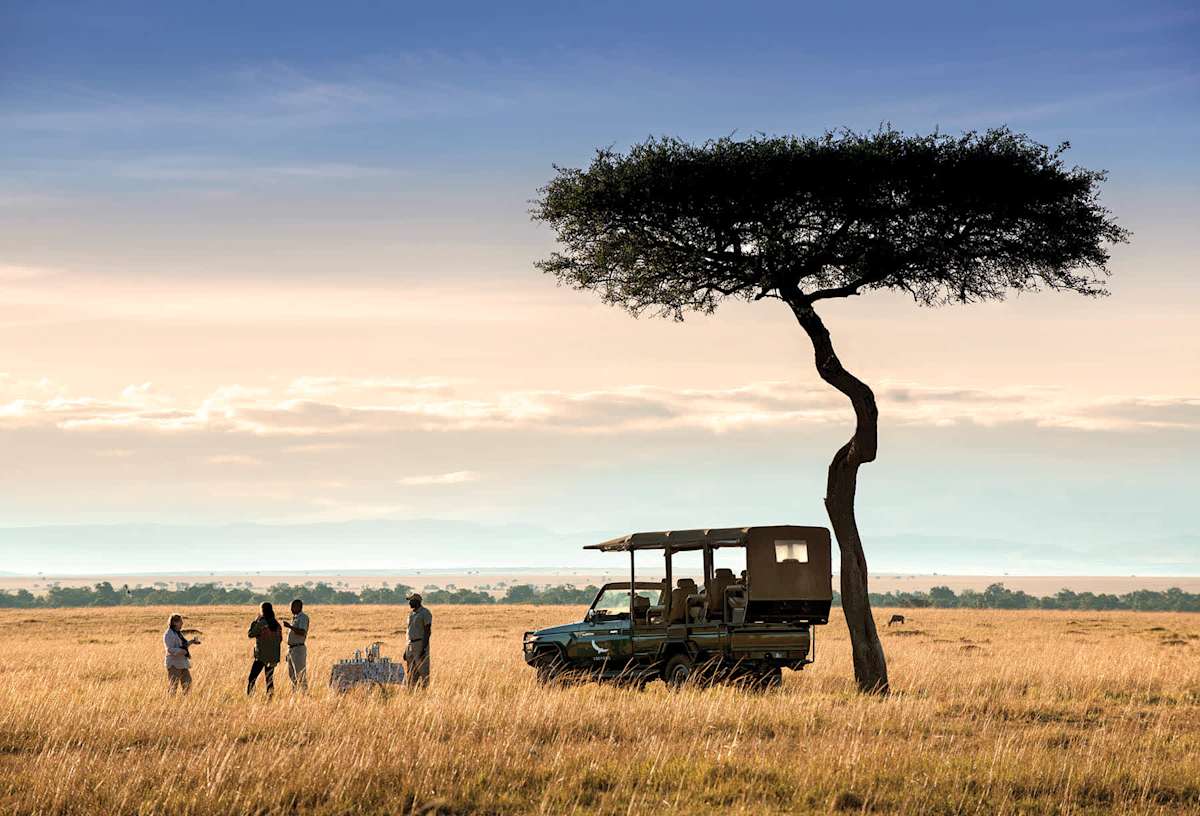
The early bird gets the coffee: On morning game drives, andBeyond guides choose a scenic spot for guests to sip an Amarula-spiked brew.
Courtesy of andBeyond
“Tourism has really protected the land here,” says Jacob Lepatim Soit, a research assistant at the Mara Predator Conservation Programme, which studies threats to the region’s top predators. “If there was no tourism, everyone would have fenced his or her own land — wildlife movement would have stopped, and the entire ecosystem would have collapsed.” Yet worries about high-season crowding have mounted in recent years. Dozens of vehicles might swarm a single rhino in the busy months of July and August, a paparazzi hive of flickering zoom lenses. “In peak season, there are a lot of cars around,” says Lepatim Soit, a Maasai raised in a nearby village. “It’s affecting the animals.” As crowding increases, fewer cheetah cubs reach adulthood, he says. Hunting patterns can transform, too. In 2025, a Maasai Mara leopard killed a mature cheetah that was surrounded by tourist vehicles, a rare event that disturbed experts. Lepatim Soit attributes the cheetah’s death to the distracting noise of radios and idling trucks, which made it difficult for her to detect the imminent danger. In search of a quieter side of the Maasai Mara, I’m visiting in May, a month when tourism tumbles nearly 80 percent from its annual peak. May is the tail end of the “long rains” that begin in March, bringing operatic storms that green its grasslands. (The Mara’s “short rains” fall in November and December, another slow season, aside from the busy holiday-vacation weeks.) I’m the only passenger in the small plane that delivers me to the Mara from Nairobi. When we touch down on the rust-colored Kichwa Tembo airstrip, unflapped zebras graze on either side. Omari greets me, and we stand together to watch the twin-propeller plane depart. Lingering in the morning sun, we are lone figures in a sea of grass that stretches to the horizon.
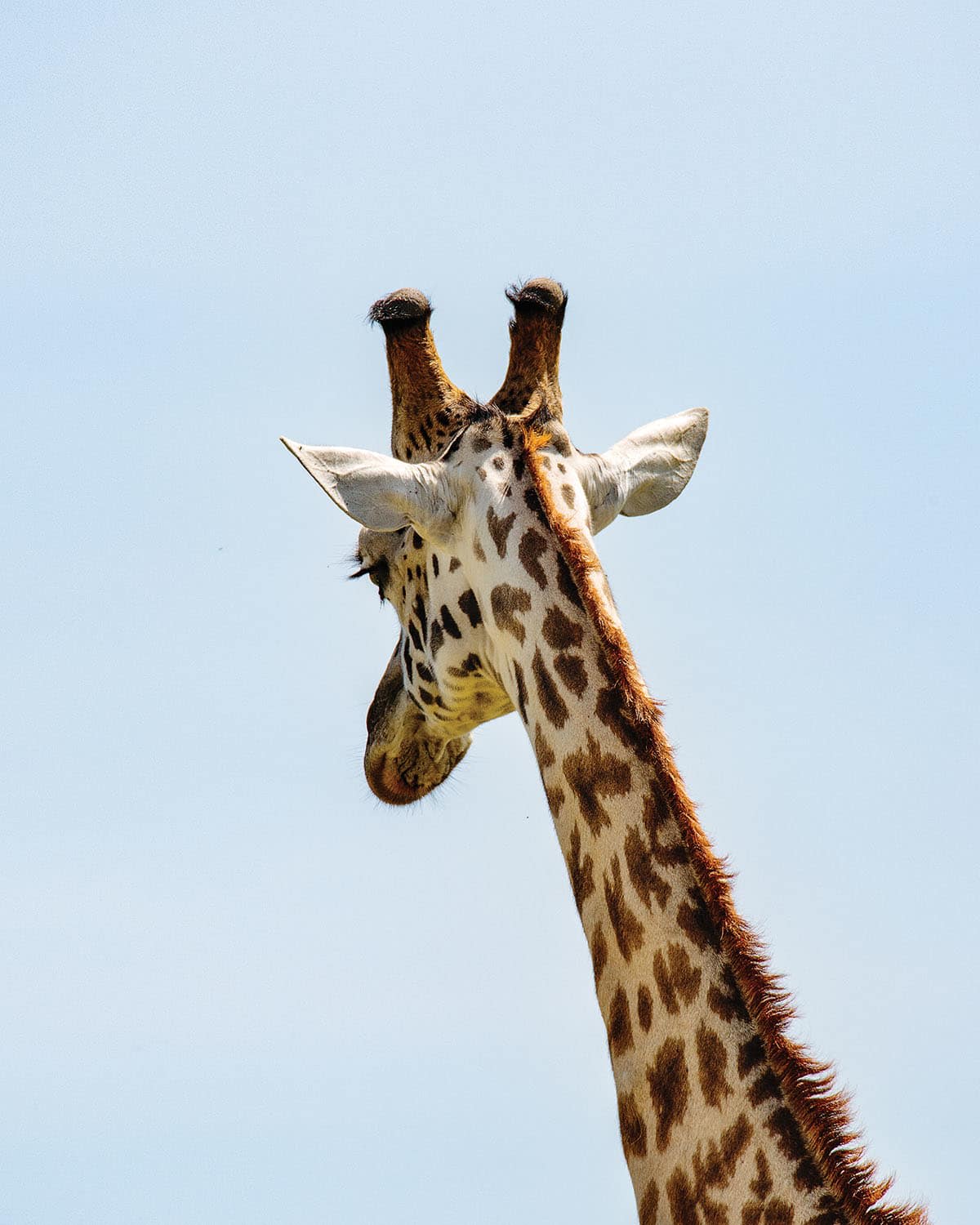
Reaching up to 19 feet, Maasai giraffes are the tallest land animals on Earth.
Alex Crétey Systermans
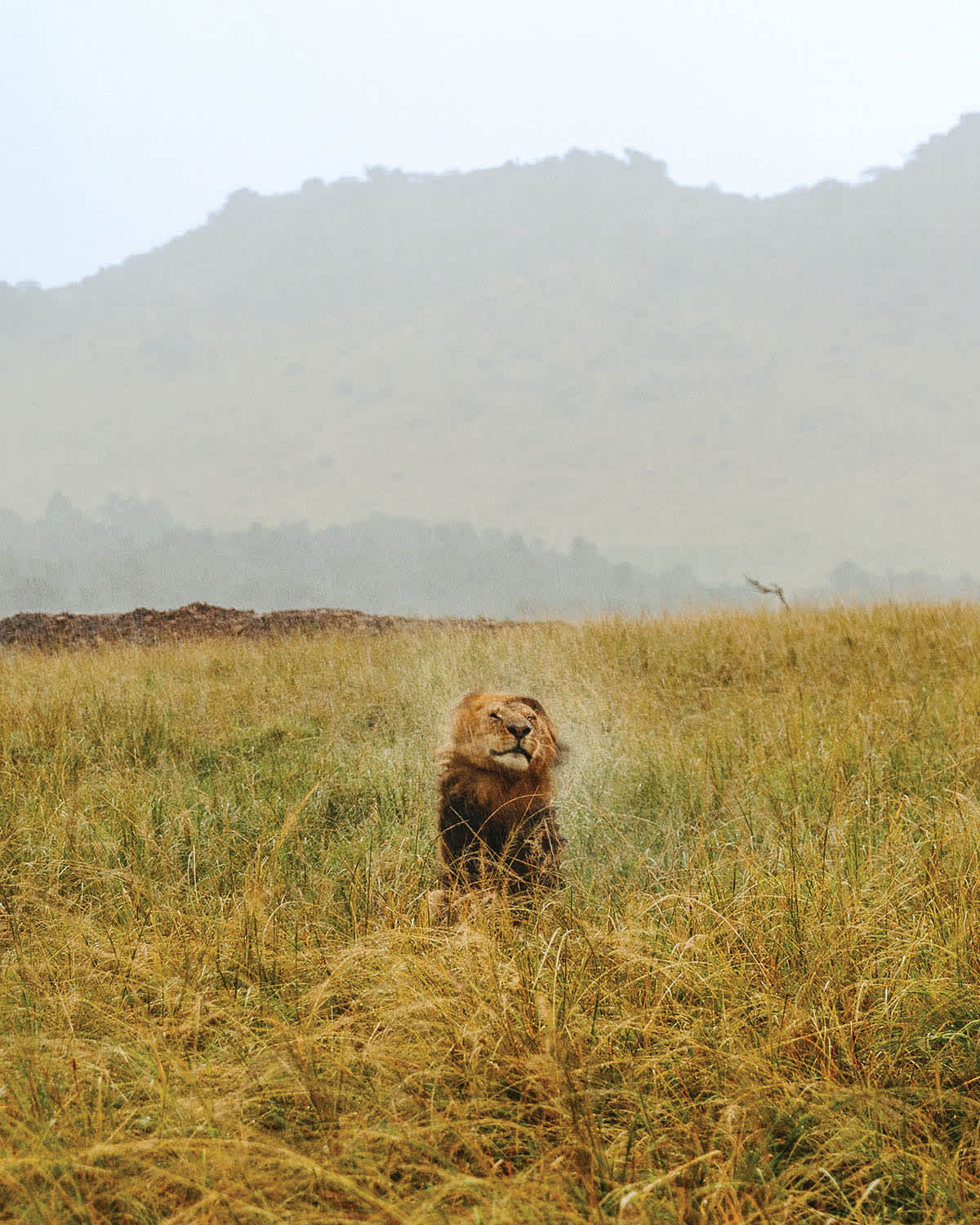
A male lion shakes off the rain during a downpour in the Mara.
Alex Crétey Systermans
“My favorite season is right now — it’s very peaceful,” says Omari as we set out on our first game drive, winding slowly toward Bateleur Camp under a sky washed clean by overnight rains. In a roadside grove, we see Maasai giraffes browsing thorny treetops, heads swiveling on the slender stalks of their necks. A round-rumped rock hyrax stands sentinel on a stone out- cropping. A family of elephants comes into view, and Omari stops in the middle of the empty dirt road. We listen to their huffing chorus as the herd overtakes us, enveloping our truck. One swings a bit wider, nudging a tiny calf in her lee. “A newborn,” Omari whispers. “No more than a few weeks old.” The baby sucks its trunk, wobbling slightly on Gumbyish legs. Spotting baby animals is one reason Ashish Sanghrajka, president and CEO of Big Five Tours & Expeditions, prefers visiting the Mara in the winter and early spring; originally from Nairobi, he travels to East Africa regularly for quiet-season safaris. “In December you start seeing some of the newborns — the entire cycle starts changing,” he says. On a recent off-season trip to the neighboring Serengeti National Park, he found himself surrounded by more than a million wildebeest. “There were live births happening around us,” he says. “We were the only vehicle there.”
Plan your ultimate adventure.
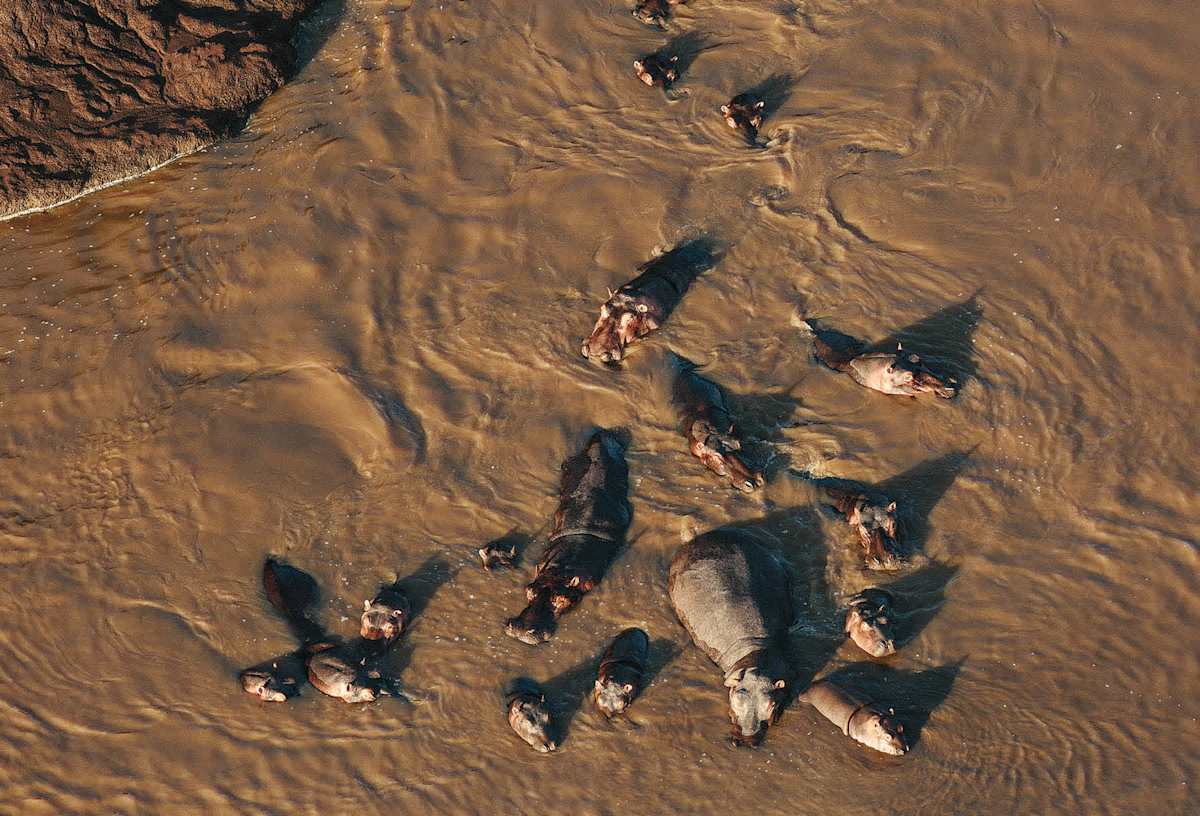
For a different perspective on the savanna, take a hot-air balloon ride, where you might soar above a “bloat” of hippos in the Mara River.
Alex Crétey Systermans
Fewer vehicles on the savanna benefits both visitors and wildlife. Human presence increases stress hormones for some animals, says Femke Broekhuis, an assistant professor at Wageningen University & Research and former director of the Mara Cheetah Project. Once, she counted 65 trucks approaching a Maasai Mara cheetah in the span of two hours; with too many people around, the cats are restless, torching precious energy stores. “They tend to be quite vigilant, and their feeding behavior changes,” Broekhuis says. She, too, prefers the off-season, and not just because it’s quieter. “You’ve got big open skies and these big stormy clouds,” she says. “It’s kind of dramatic.” At first, the skies open only at night. Downpours ripple the canvas roof of my tent as I sleep. By the time I carry a mug of strong coffee — slipped into an outside alcove by Simon, the butler — onto my veranda with views across nearby plains, the clear dawn silhouettes a long line of elephants. But on the third day of my trip, gray-bellied clouds bubble skyward in the early-afternoon heat. Omari and I are side by side, outside our truck above the mud wallows of the Mara River. An elephant bathes midstream, anointing itself with trunk-blasts of river water. Near the banks, hippos are submerged to their eyes. A young calf necklaced in fat rolls leans on its mother’s haunch.
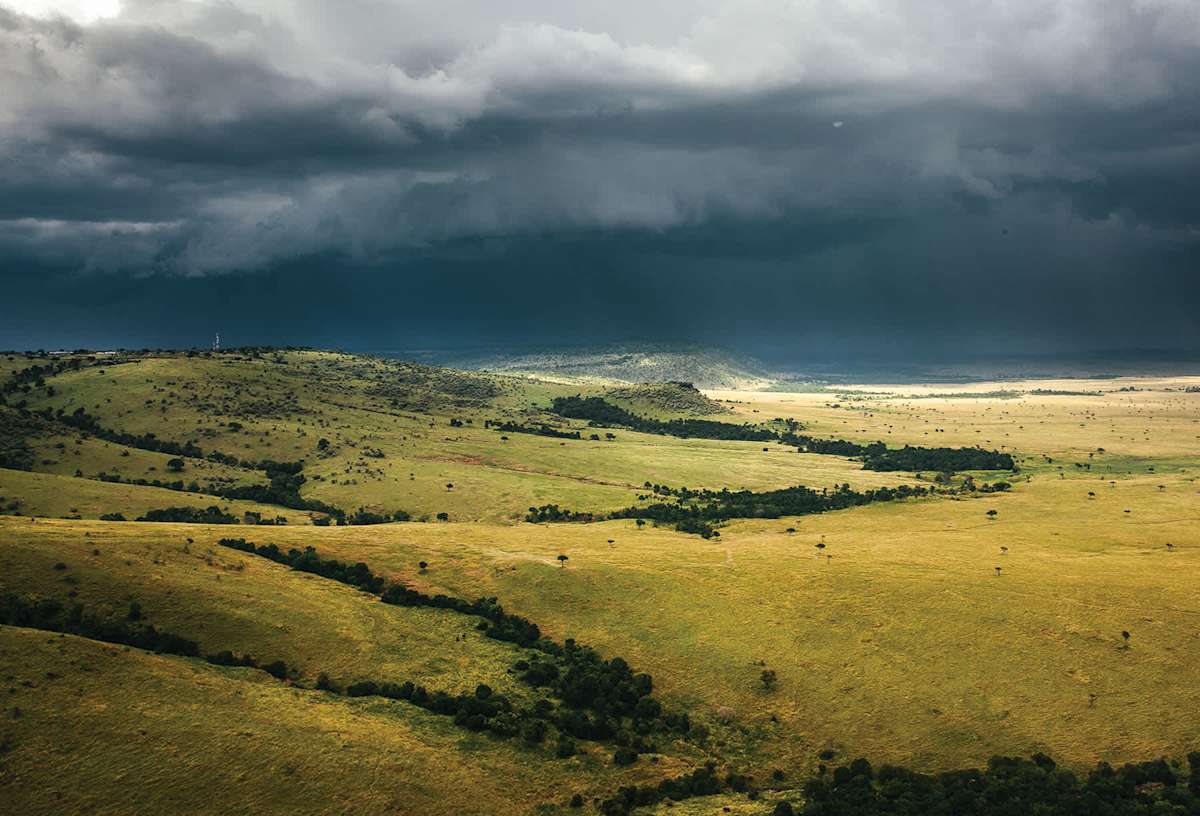
Dark, dramatic skies are a common sighting during the Mara’s green season.
Alex Crétey Systermans
The first spattering drops fall by the riverbank. At Bateleur Camp, the storm swells to a cool torrent. When I reach my tent, I find Simon has filled my hand-hammered copper tub to the brim, petals scattered across its steaming surface. Setting a brandy decanter within arm’s reach, I slip into the water. The short and potent storm roars away outside, drumming at my tent’s glass atrium. Thinking of the hippos, I sink in to my eyeballs. When I’d arrived, three days before, Omari had asked me what I hoped to see. I’d laughed at the question. I wanted to see everything, all of it — yet I could have contentedly passed the trip watching warthogs root up the grass by Bateleur Camp’s almond-shaped infinity pool, one of two on the property. “Sometimes it’s not what you see, but how you see it,” agreed Omari. Safari’s richest pleasures are often the most minutely etched: the lazy twitch of a sleeping lion flicking flies, evening sun blazing on steep escarpments. So, on my final evening at Bateleur Camp, we set out at our ease, content, no checklist in mind. Then, Omari spots a telltale duo of horns in tall grass nearby: a critically endangered black rhino, all but unseen in the lush undergrowth.
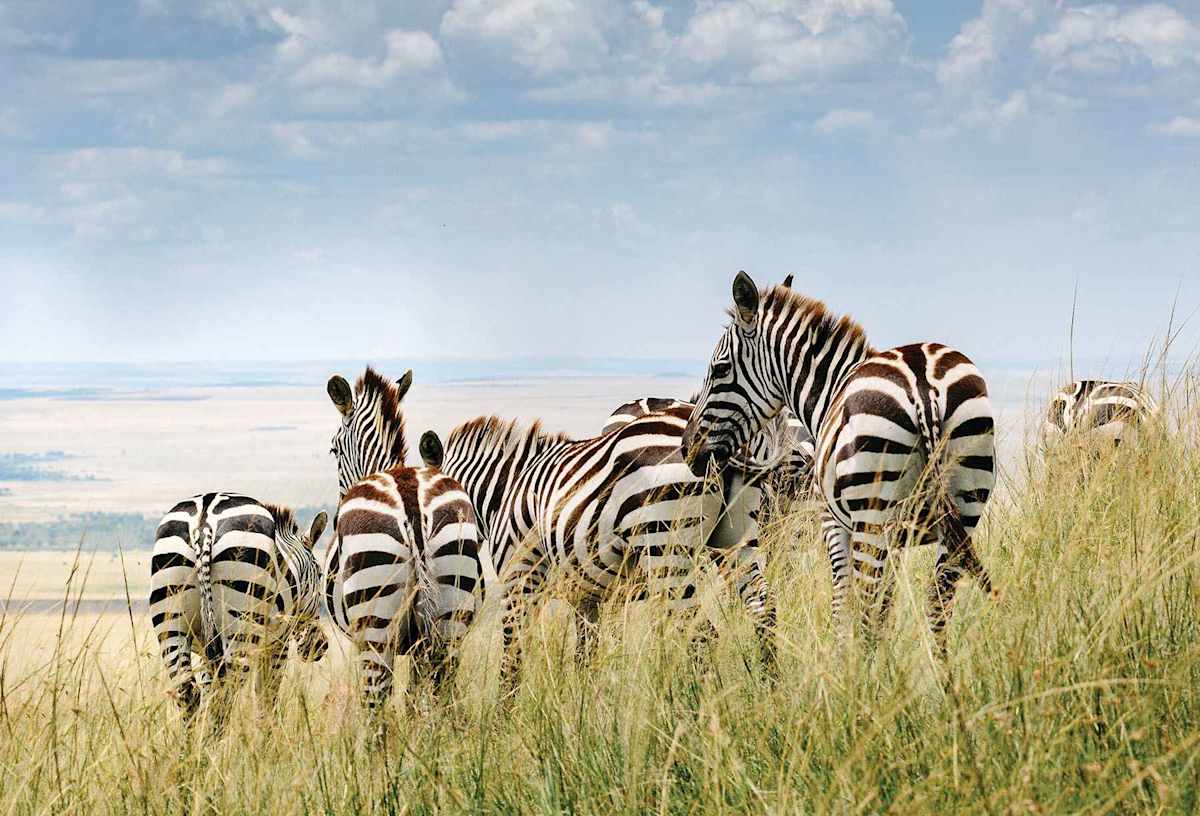
Spotting a “dazzle” of zebras is one of the many delights of a Maasai Mara safari; peak green season in the Mara.
Alex Crétey Systermans
Rains had draped the savanna in secrecy. The horns bob amid gold-tipped grass, inky masts on a dimly sunlit sea. “There’s a baby,” Omari breathes. He’s located a young calf, its tiny nub of horn a gray smudge. The pair steps into a clearing, and the calf appears. Snouty and small, it barely reaches its mother’s knee. We stay in silence as the sun slips lower, leaving the Mara as dusk darkens the eastern sky. “Are you happy?” Omari asks. I am, of course. The sudden outrush of fragile beauty has left me humming, elated. The rainy season’s tall grass is a haven for those animals who crave a thicket’s privacy, which means they’re sometimes harder to spot. But the resulting encounters are electric with serendipity. It’s dark as Omari drives toward Bateleur Camp. At the sides of the narrow road, the truck’s headlights — the beams a chaos of insects — illuminate long grassy hanks. Omari stops as a slender figure steps onto the dirt track. The serval cat has a spotted pelt, its ears an improbable batwing swoop. It looks poised as a pharaoh as it sits, giving us both a long look. Then it leaps, kittenish, into the grass once more. Omari grins at the rare sight. “Now I am happy, too!” ✦
Explore More
An Expert’s Guide to Planning Your First African Safari Vacation: Four Ensemble travel advisors break down what it really takes to plan the ultimate adventure. A Deep Dive Into Zambia’s Natural Wonders: In the African savanna to see its iconic wildlife for himself, writer J.R. Patterson finds that the animals, conservation and tourism are closely intertwined. You Can Experience a Picnic on a Desert Island: This daytime escape in Mozambique comes with white tablecloths, skewers and spicy cocktails. Follow Range on Instagram, Facebook and Pinterest. Sign up for the Range newsletter to receive expert advice, award-winning stories and the latest travel trends in your inbox.